Zing Coach / AI Coach
Designing an adaptive AI coaching system for fitness retention.
How we moved Zing from static workout plans to a contextual AI coach that helps users start training, adapt their plan, and build consistency.
The goal was not to add a chatbot to a fitness app. The goal was to make Zing behave more like a real coach: aware of the user's goal, plan, history, feedback, body metrics, and training context.
At a glance
Key numbers
Week-1 adherence is measured by users completing 2+ workouts in their first 7 days — the threshold behind the retention target above.
Context
Fitness apps often fail not because they lack content, but because users struggle to turn intention into a habit.
Many users sign up with a clear goal, but then real life gets in the way. They skip the first workout, feel unsure if the plan fits them, don't understand why certain exercises are recommended, or lose motivation when progress feels slow.
For Zing, this created a strategic retention challenge. A large share of users never reached the first meaningful workout milestone. If users did not start training, the quality of the workout plan could not matter yet.
This changed how we framed the AI Coach. It could not be a generic chat interface for fitness questions. It had to become a coaching layer that helped users through the moments where they usually dropped off:
- before the first workout
- after a missed workout
- after a hard session
- when the plan felt too rigid
- when progress was unclear
- when the user needed reassurance that the next step was right
Activation cliff: Subscribed users → started first workout → completed 2 workouts → active at week 4. 55% never start a workout; 2 workouts is the key activation milestone; W4 workout retention is the core retention outcome.
The product challenge
How might we make a digital fitness app feel more like a real coach?
A real coach does more than give a workout plan. They assess, explain, motivate, monitor, adjust, keep the client accountable, and help them stay safe. We used this as the foundation for the AI Coach experience. Internally, the AI fitness coach was defined around seven core jobs:
- Assess the user's current fitness level, limitations, and goals
- Design a personalized program
- Motivate users to build wellness habits
- Educate users on fitness, wellness, nutrition, and technique
- Monitor performance and show progress
- Keep users accountable
- Keep users safe
The desired qualities were also clearly defined: proactive, hyper-personalized, empathetic, and supportive.
Research insight
Users did not want another generic fitness chatbot. Research with 56 gym-focused Zing users showed the AI Coach already had a strong foundation: 68% found its guidance often or almost always relevant.
But the largest opportunity was adaptation. When asked what they wanted the AI Coach to do well, 57% wanted adaptive workout programming based on progress, preferences, and feedback. Another 30% wanted the AI to listen and respond to feedback better.
This exposed the main product gap: users were not asking for more general fitness advice. They wanted a coach that could understand their actual plan, remember their preferences, respond to their workout feedback, and make practical changes.
Users do not need more fitness information. They need confidence that today's next step is right for their body, goal, schedule, and progress.
The personalization gap
The same research showed most users felt Zing understood them to some degree, but only a smaller group felt the experience was genuinely personalized.
Good foundation, but not yet "built for me."
What users wanted the coach to understand
Users also wanted deeper data integration — reinforcing that better coaching required better context.
Personalization depends on connected context.
Strategy
We reframed the AI Assistant from a chat feature into a coaching system. Chat was only one surface. The actual experience needed to connect multiple layers:
- Conversational AI for dialogue, explanations, motivation, and feedback
- Workout recommender for plan generation and adaptation
- User context — goal, profile, workout history, Apple Health data, body scan, strength score, recovery, and fitness tests
- Proactive services for check-ins, reminders, and accountability
- Workout and progress surfaces where coaching moments appear in context
The long-term product direction was to integrate the Recommender, Conversational AI, and Zing AI Lab into a unified experience that could deliver a service closer to a remote real coach.
System flow: User context → Recommender → Conversational AI → Proactive services → Product surfaces.
Design principles
Make the coach contextual
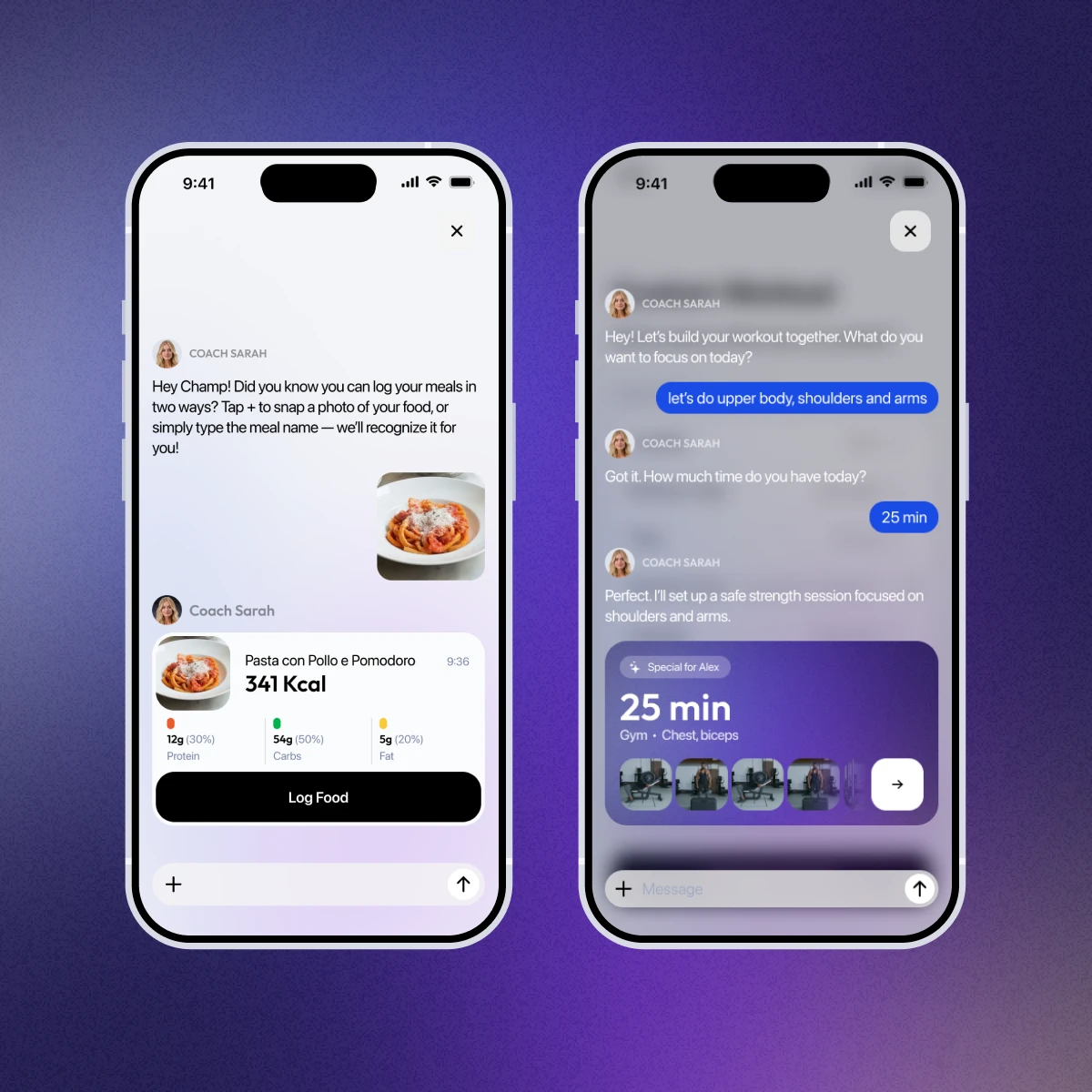
The first design shift was moving from passive Q&A to contextual coaching. Instead of expecting users to open a chat and type a question from scratch, we embedded relevant coaching prompts into key moments of the product: workout screens, body scan results, progress insights, and plan explanations.
The assistant could use context from the user's profile, preferences, workout plan, workout history, fitness tests, body scan, strength score, and other product data — making it feel less like a general-purpose AI and more like a coach that understood the current situation. Examples of contextual prompts:
- "Why is this workout recommended today?"
- "How should I adjust if I feel sore?"
- "What does my body scan result mean?"
- "How can I improve my strength score?"
- "Can I replace this exercise?"
- "Why did my recovery score change?"
Make the coach proactive
A real coach does not wait until the client asks for help. They follow up, notice missed sessions, ask what happened, and help the user recover from imperfect weeks. We designed proactive AI check-ins around the first activation milestone: helping new subscribers complete their first two workouts.
The check-in framework followed a simple behavioral loop:
Positive reinforcement → insight for improvement → solution → commitment.
The assistant would ask about barriers, understand the user's goal and conditions, suggest a plan adjustment, ask for explicit commitment, and help set reminders. The primary success target was the percentage of new subscribers completing two workouts in the first two weeks, supported by check-in starts, check-in completion, CSAT, and cancellation rate.
Move from advice to action
One of the biggest UX challenges in AI products is the gap between advice and action. A generic chatbot can say "You should reduce workout intensity." A useful AI coach should say "Based on your feedback, I can reduce your workout duration to 30 minutes, 4 days per week. Do you want me to update your plan?"
This shift introduced a more agentic interaction model: understand user feedback, explain the recommended change, preview the plan adjustment, ask for explicit confirmation, apply the change, and follow up after the next workout. Plan adjustments could include workout duration, frequency, schedule, home/gym mix, intensity, preferred exercises, warm-ups, cooldowns, injuries, and target muscle focus.
Make progress understandable
Fitness progress is slow and often invisible. Users may follow the plan but still feel unsure if they are improving. The AI Coach needed to connect progress data — body scan results, strength score, recovery, workout history — to clear explanations and next steps. The broader strategy also prioritized insights inside user analytics, progress tracking, recovery/readiness, and weekly or monthly health and progress reports as part of the transition toward daily coaching.
AI UX interaction patterns
The AI Coach experience required a different design approach from traditional app flows. Traditional UX is usually deterministic — users tap, the app responds predictably. AI UX is more dynamic: users can say anything, the model can answer in many ways, and the experience depends on context quality, prompt quality, safety, and trust. We approached the interaction model through several patterns:
Measurement model
We evaluated the AI Coach through a combination of activation, engagement, retention, business, and quality metrics. The primary activation metric was the percentage of subscribers who completed two workouts within the first two weeks after installing the app, supported by W1 workout retention, conversion into the first AI Assistant message, and retention to AI Assistant communication.
AI success was measured by behavior change, not chat volume alone.
Business opportunity
The AI Coach also had strategic value as a retention and competitive moat. Research with gym-focused users showed strong loyalty signals:
But loyalty was not unconditional. The biggest churn risks were:
This made adaptive coaching strategically important. If a competitor offered better programming, better adaptation, or better AI, users could switch. But if Zing could make the coach feel truly personal, adaptive, and useful in the workout flow, it could become a stronger reason to stay.
Trade-offs and constraints
Designing an AI coach in a health and fitness product required several important trade-offs.
AI coaching requires designing both capability and restraint.
Impact
The AI Coach became a strategic layer for improving retention, activation, engagement, and product differentiation — helping define Zing's transition from a weekly workout app to a daily coaching platform that can guide users before a workout, during training, after missed sessions, and while interpreting progress.
- Defined the AI Coach experience around seven core coaching jobs
- Reframed AI from chatbot to adaptive coaching system
- Designed proactive check-ins for first-workout activation and missed-workout recovery
- Connected AI coaching to user context: goals, plan, workout history, body scan, strength score, recovery, and health data
- Introduced interaction patterns for AI-assisted plan adaptation
- Created a measurement model combining safety, usefulness, engagement, retention, and cancellation impact
- Supported the strategic shift toward daily coaching and habit-building
Strategic target
For 2026, the product direction evolved into an AI Activity Coaching Engine, with Superpersonalized Journeys targeting a +50% relative lift in W4 Workout Retention. Daily Activity Coaching introduced Habit Rate as a leading metric: the percentage of weekly active users with 3+ coaching days per week. A coaching day required a meaningful action, such as completing a workout, completing a micro-activity, submitting a coach check-in, or completing a nutrition action.
Supporting metrics: week-1 adherence · 2+ workouts in first 7 days · Habit Rate · 14-day cancellation rate as guardrail.
The goal was not more AI usage. The goal was stronger fitness retention.
Reflection
The biggest product shift was not adding AI to the app. It was designing a system where AI could become useful at the moments where users usually drop off: before the first workout, after a hard session, after a missed workout, when progress feels unclear, or when the plan no longer fits real life.
The main learning was that trust in AI coaching does not come from sounding human. It comes from being specific, contextual, safe, and able to help the user take the next step. A generic assistant can answer fitness questions. A real AI coach needs to understand the user, adapt the plan, explain progress, and keep the user accountable without judgment.
That was the design challenge behind Zing AI Coach.